
From Dough to Data: Scaling Bakeries with Microsoft Dynamics 365 ERP and CRM
Published in Microsoft Dynamics 365 on May 13, 2026 | 9 min read
Written by Lakshmi Murali , Microsoft Dynamics 365 Techno Functional Consultant at Woxro, skilled at translating complex business requirements into practical Dynamics 365 solutions, with a strong focus on aligning technology capabilities with real world operational and growth objectives.

Overview
- The Modern Bakery Landscape: Growth Comes with Complete
- Why Traditional Systems Start Breaking at Scale
- The Role of a Modern CRM Layer in Bakery Sales
- ERP CRM Integration The Real Game Changer
- Simplifying Data and Customer Complexity in Bakery Sales
- Phased Implementation A Practical Blueprint for Bakery Digital Transformation
- Improving Demand Forecasting and Production Planning
- Unified Finance, Sales, and Operations - One Version of the Truth
- Real World Impact Where Tradition Meets Scalable Growth
- From Dough to Data A Smarter Way Forward
The bakery and confectionery industry has always been a blend of craft and consistency. Recipes are refined over years, production processes are carefully calibrated, and quality is non negotiable. Yet as bakeries grow beyond local markets into wholesale, retail chains, and institutional supply, a new challenge emerges in the form of operational complexity. Growth brings volume. Volume brings data. Without the right systems in place, data quickly shifts from being an asset to becoming a liability. This is where modern ERP and sales automation platforms such as Microsoft Dynamics 365 are reshaping how bakeries operate, sell, and scale, while still preserving the traditions that made them successful. This blog explores how bakeries and confectionery manufacturers are addressing real world challenges through integrated ERP and CRM strategies, and how the shift from dough to data is becoming a competitive necessity rather than just a technology upgrade.
The Modern Bakery Landscape: Growth Comes with Complete
Bakery businesses today operate in a significantly more complex environment than they did a decade ago. As they scale, operations expand across products, customers, and compliance requirements, increasing the need for better coordination and visibility across the business. While production and manufacturing systems often mature early, sales operations frequently lag behind, relying on manual processes, fragmented customer data, and spreadsheet driven reporting. Over time, these gaps introduce inefficiencies that directly impact profitability, accuracy, and customer satisfaction.
Most growing bakeries now manage the following complexities:
- Multiple product lines including fresh, frozen, seasonal, and specialty items
- Diverse customer segments such as distributors, retailers, institutions, and direct B2B buyers
- Strict food safety, traceability, and compliance requirements
- Fluctuating raw material costs that affect pricing and margins
- Increasing customer expectations for faster fulfillment and greater transparency
While production systems often mature early, sales operations tend to lag behind. Orders are taken manually, customer data is fragmented, and reporting relies heavily on spreadsheets. Over time, these gaps create inefficiencies that directly impact margins and customer satisfaction.
Why Traditional Systems Start Breaking at Scale
Many bakeries continue to depend on legacy ERP systems that have proven their reliability over the years. These platforms are highly effective at managing core operational functions such as inventory control, manufacturing processes, batch tracking, product costing, and accounting. For production focused environments, they provide stability and control, which is why they remain deeply embedded in day to day operations.
However, as bakeries grow and sales channels expand, the limitations of these traditional systems become increasingly visible. Most legacy ERP platforms were never designed to support dynamic sales pipelines, complex customer segmentation, or real time sales visibility. They lack the flexibility required to manage modern sales cycles where customer expectations, pricing structures, and order volumes vary significantly across different segments.
As sales activity increases, teams often struggle with fragmented data and manual workarounds. Customer records become duplicated across systems, pricing and discount structures lose consistency, and order confirmations are delayed due to disconnected workflows. Without accurate and timely sales data, demand forecasting becomes unreliable, making it difficult for production and procurement teams to plan effectively. The core issue is not the ERP system itself.
These platforms continue to perform well in their intended operational roles. The real challenge lies in the absence of a connected sales layer that can bridge customer interactions with backend operations. Without this connection, bakeries find it difficult to scale sales efficiently while maintaining accuracy, visibility, and control across the business.

Sales intelligence is centered on gaining a deeper understanding of customer buying behavior, predicting demand with greater accuracy, and reducing manual intervention across the sales process. It also plays a critical role in aligning sales commitments with actual production capacity, ensuring that what is sold can be delivered reliably. Achieving this level of intelligence requires a platform that sits between customers and operations, capturing sales data in real time while remaining closely connected to backend systems that manage inventory, production, and fulfillment.

The Role of a Modern CRM Layer in Bakery Sales
In a growing bakery or confectionery business, sales complexity increases much faster than production complexity. A modern CRM layer addresses this gap by becoming the central nerve center for all sales related activities, connecting people, processes, and data into one structured system. Instead of sales information being scattered across emails, spreadsheets, and individual inboxes, everything is captured, organized, and accessible in a single unified platform.
At the foundation of this CRM layer is centralized customer and debtor management. Bakeries typically work with a wide range of customers such as distributors, retail chains, institutional buyers, and smaller wholesale accounts, each with different pricing terms, credit limits, and payment behaviors. A modern CRM consolidates all customer related data into one place, giving sales teams instant visibility into customer history, outstanding balances, order patterns, and engagement status. This enables more informed conversations, faster decision making, and better credit control without manual follow ups.
Another critical capability is the ability to define distinct sales cycles for different customer types. A high volume distributor may follow a very different sales process compared to a seasonal or ad hoc buyer. A CRM allows bakeries to configure structured sales journeys for each segment, ensuring that approvals, pricing checks, and order confirmations happen consistently. This removes ambiguity from the sales process and ensures that every deal follows a predictable and controlled path.
Modern CRM systems also support lead and inquiry tracking, including requests coming from websites, emails, and other digital channels. Instead of inquiries being missed or delayed, every lead is captured, assigned, and tracked through to closure. This improves response times, increases conversion rates, and ensures that potential business opportunities are not lost, especially during peak demand periods.
Opportunity management and sales forecasting further strengthen planning and coordination. By tracking opportunities at each stage, sales teams gain clear visibility into what is likely to close, when it will close, and at what value. This insight helps management align sales expectations with production planning and inventory availability, reducing last minute pressure on operations and improving overall efficiency.
Quotation and pricing workflows add another layer of control and consistency. Bakeries often manage complex pricing structures influenced by volume commitments, customer agreements, and seasonal factors. A CRM enforces pricing rules, approval thresholds, and discount limits, ensuring that quotations remain accurate, compliant, and profitable while still allowing controlled flexibility.
Finally, sales order creation and tracking within the CRM ensures a smooth transition from sales to operations. Once an order is confirmed, it is recorded and monitored through fulfillment and invoicing stages. Sales teams can proactively communicate order status to customers, improving transparency and trust, while operations teams receive clean and structured data that reduces rework and errors.
With these structured workflows in place, bakery sales teams move away from reactive order handling toward proactive planning and relationship management. Every interaction becomes traceable, measurable, and actionable, enabling bakeries to scale sales operations with confidence while maintaining control, consistency, and customer satisfaction.
ERP CRM Integration The Real Game Changer
Sales automation alone delivers limited value when it operates in isolation. The true impact is achieved when customer relationship management systems and enterprise resource planning systems function together as a unified platform. In a fully integrated environment, customer information remains consistent across all business systems, removing duplication and eliminating data mismatches that often slow down operations.
With ERP CRM integration, product information pricing structures and discount rules are always current and aligned. Sales teams no longer rely on outdated price lists or manual confirmations, which significantly reduces errors during order creation. Sales orders move seamlessly from the sales system into operational workflows, allowing production inventory and fulfillment teams to act immediately without delays or rework.
Equally important, invoice details payment status and outstanding balances are clearly visible to sales teams in real time. This visibility enables more informed customer conversations improves credit control and supports healthier cash flow. By synchronizing data in both directions between sales and operations, organizations remove information silos and establish a single source of truth. The result is a connected business where sales growth is supported by operational accuracy and long term scalability.
Simplifying Data and Customer Complexity in Bakery Sales
One of the most underestimated challenges in bakery digital transformation is historical data migration. Over the years, bakeries accumulate extensive customer transactions, invoices, pricing agreements, and credit records across legacy systems and spreadsheets. This data is often inconsistent, poorly structured, and difficult to map into modern platforms without losing context. Treating migration as a purely technical task frequently leads to duplication, reporting gaps, and reduced confidence in the new system, ultimately impacting sales visibility and decision-making.
A successful approach views historical data as a business asset that must be curated, not simply transferred. This involves cleaning and validating customer records, removing redundancies, standardizing pricing structures, and prioritizing business-critical data such as active customers, open invoices, and recent transaction history. Maintaining the relationships between customers, orders, and invoices is essential to preserve continuity for sales and finance teams. When executed correctly, historical data becomes a foundation for accurate forecasting, trend analysis, and meaningful customer insights rather than a legacy constraint.
At the same time, bakeries must manage the complexity of serving multiple customer types from large distributors and retail chains to institutional buyers and smaller B2B customers. Each segment operates with different pricing logic, credit terms, approval workflows, and delivery expectations. A flexible, integrated CRM–ERP setup enables bakeries to handle these variations within a single, structured framework. Sales teams follow defined processes tailored to each customer category, while the system automatically enforces consistency, compliance, and financial controls. This ensures that growth does not add operational friction, allowing bakeries to scale sales efficiently while maintaining accuracy and control.

Phased Implementation A Practical Blueprint for Bakery Digital Transformation
Phased ERP implementation has become one of the most reliable strategies for bakeries undertaking digital transformation because it aligns with the realities of food production and continuous sales operations. Bakeries cannot afford system downtime or sudden process changes that interrupt manufacturing schedules or order fulfillment. A phased approach allows businesses to modernize in controlled stages, introducing improvements gradually while keeping core operations stable and predictable.
The first stage of this approach focuses on building a strong and structured sales foundation. Customer records are standardized, sales processes are clearly defined, and visibility is established across opportunities quotations and sales orders. Sales teams move away from manual tracking and fragmented communication and begin working with consistent data and repeatable workflows. This stage delivers immediate benefits such as improved accuracy faster response times and clearer insight into the sales pipeline which helps build confidence and user adoption early in the transformation journey.
Once sales processes are stabilized the next stage introduces integration with existing ERP systems in a measured and controlled manner. Customer and product data are synchronized to ensure consistency while sales orders invoices and reporting information flow seamlessly across systems. Because users are already familiar with the new sales processes integration feels like a natural extension rather than a disruptive change. This gradual progression minimizes risk preserves business continuity and ensures that the digital transformation supports sustainable growth without compromising day to day bakery operations.
Improving Demand Forecasting and Production Planning
Accurate demand forecasting is especially critical in the bakery industry, where products have limited shelf life and freshness directly impacts customer satisfaction. When sales and operational data are integrated, bakeries gain a clear and reliable view of real demand patterns rather than relying on assumptions or manual estimates. Historical sales trends combined with current order pipelines help production teams plan batches more precisely and align output with actual market needs.
Integrated data also makes seasonal demand far more predictable. Festivals promotional periods and recurring bulk orders can be identified early allowing production schedules raw material procurement and workforce planning to be adjusted in advance. This proactive approach significantly reduces overstocking last minute production pressure and unnecessary wastage which directly improves margins in a high volume low margin industry.
As forecasting accuracy improves confidence grows across teams. Production teams can trust the demand signals coming from sales while sales teams commit to delivery timelines that are realistically achievable by operations. This alignment creates a balanced planning cycle where commitments are data driven risks are minimized and both sales and production move forward with clarity and control.
Unified Finance, Sales, and Operations - One Version of the Truth
Modern bakeries and confectionery businesses can no longer afford fragmented systems where finance, sales, and operations operate in silos. With Microsoft Dynamics 365, these critical functions are brought together into a single, connected ecosystem. Production costing, real-time profit and loss visibility by product line, and distributor and retail sales insights flow into one consolidated view.
For leadership teams, this means decisions are no longer based on delayed reports or stitched-together spreadsheets. Instead, they gain a unified dashboard with real-time KPIs, instant performance visibility, and the ability to act faster and with greater confidence. The outcome is sharper governance, better financial control, and clarity across the business without the overhead of manual reconciliations or constant Excel workarounds.
Real World Impact Where Tradition Meets Scalable Growth
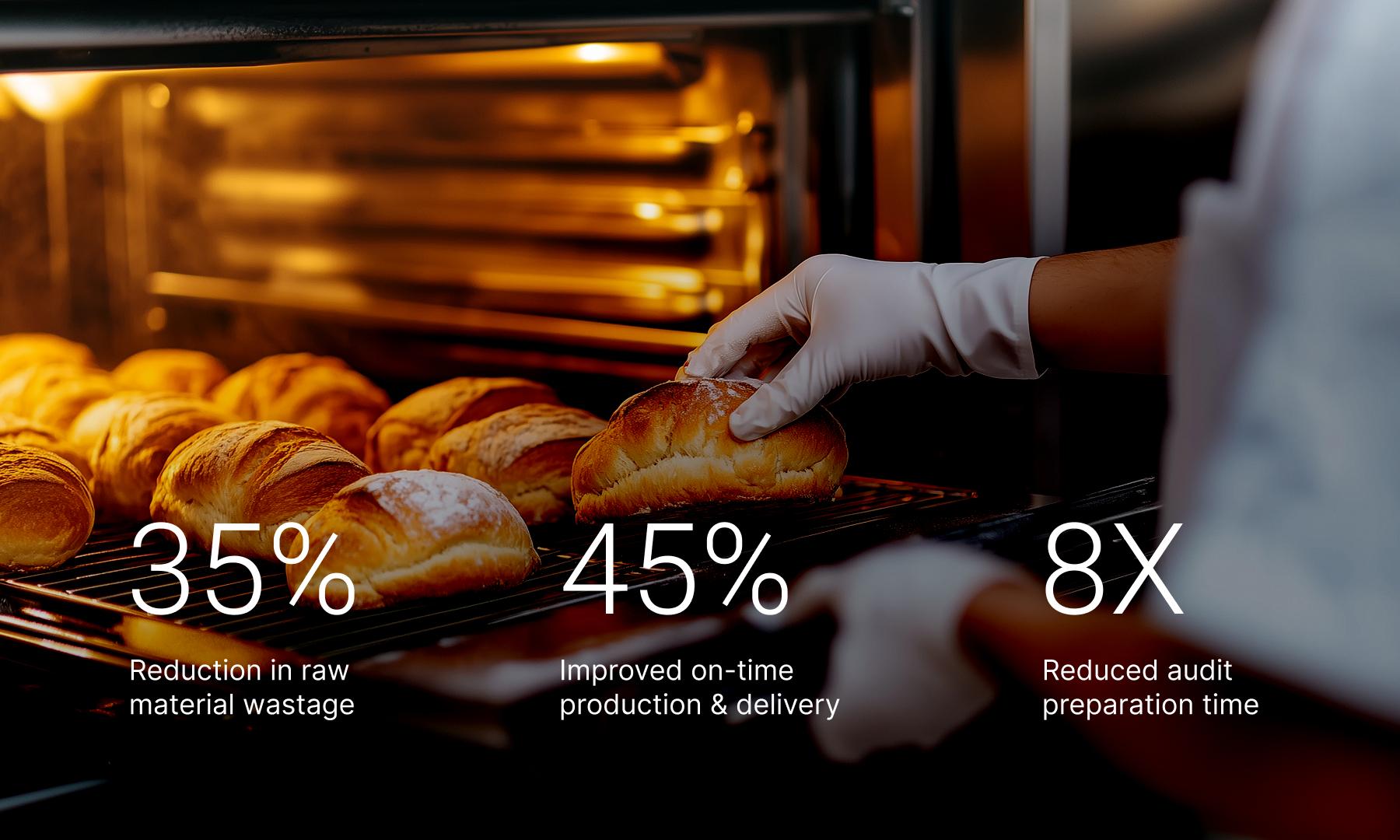
When bakeries align technology with operational discipline, the outcomes are clearly measurable. As reflected in the image, integrated and data driven systems enable bakeries to achieve up to 35 percent reduction in raw material wastage, ensuring stronger control over ingredients and significantly lower production losses. At the same time, businesses experience up to a 45 percent improvement in on time production and delivery, strengthening distributor confidence and customer satisfaction across all sales channels.
Compliance and governance also improve substantially. With standardized and system driven processes in place, audit preparation time can be reduced by up to eight times, removing the burden of manual documentation and last minute reconciliations. This operational clarity allows bakeries to expand into new locations, channels, or product lines with greater confidence, as the underlying processes remain consistent, controlled, and scalable.
This success is not theoretical. It represents execution excellence in practice. While the baking industry is rooted in tradition, sustainable growth depends on intelligence and precision. By preserving recipe integrity, standardizing operations, and enabling scale without chaos, bakeries can confidently compete with larger global players. In leadership terms, the equation is simple. Operational efficiency combined with compliance and scalability results in sustainable growth. Put simply, the same great taste is delivered by a much smarter business.
From Dough to Data A Smarter Way Forward
Digital transformation in the bakery and confectionery industry is not about replacing tradition but about strengthening it. By reducing administrative complexity and improving operational visibility, businesses create more time and focus for what truly matters product quality consistency and customer satisfaction. Technology becomes a silent support system that protects craftsmanship rather than competing with it.
As bakeries grow in scale and complexity, intelligence and integration become essential. When modern sales automation is layered thoughtfully over existing operational systems, businesses gain better coordination between sales finance and production. This alignment enables smoother operations faster responses to market demand and the flexibility to scale without losing control or reliability.
Moving from dough to data is therefore not a passing trend but a strategic shift. Bakeries that adopt this approach with clarity and purpose position themselves for sustainable growth stronger competitiveness and long term resilience. The result is a business that honors its heritage while operating with the confidence and agility required for the future.

E commerce Development
Building an effective Ecommerce requires ongoing updates and adaptations to meet changing consumer preferences and technological advancements and thus enhance your competitiveness, foster customer loyalty, and ultimately drive growth in an ever-changing marketplace.
Claim your free ERP Implementation guide!
Subscribe to receive updates and insights directly in your inbox!
Start Your Digital Journey Today !
Discover proven ERP rollout strategies and request a tailored implementation quote.